Visual Reconciliation: Using VLMs to Automate ERP Document Ingestion
Leveraging vision-language models to bypass legacy OCR limitations and automate the ingestion and matching of complex financial documents directly into ERPs.
Why does this article matter to your business?
Drop your company URL. Our AI reads your site and tells you exactly how this article applies to what you do.
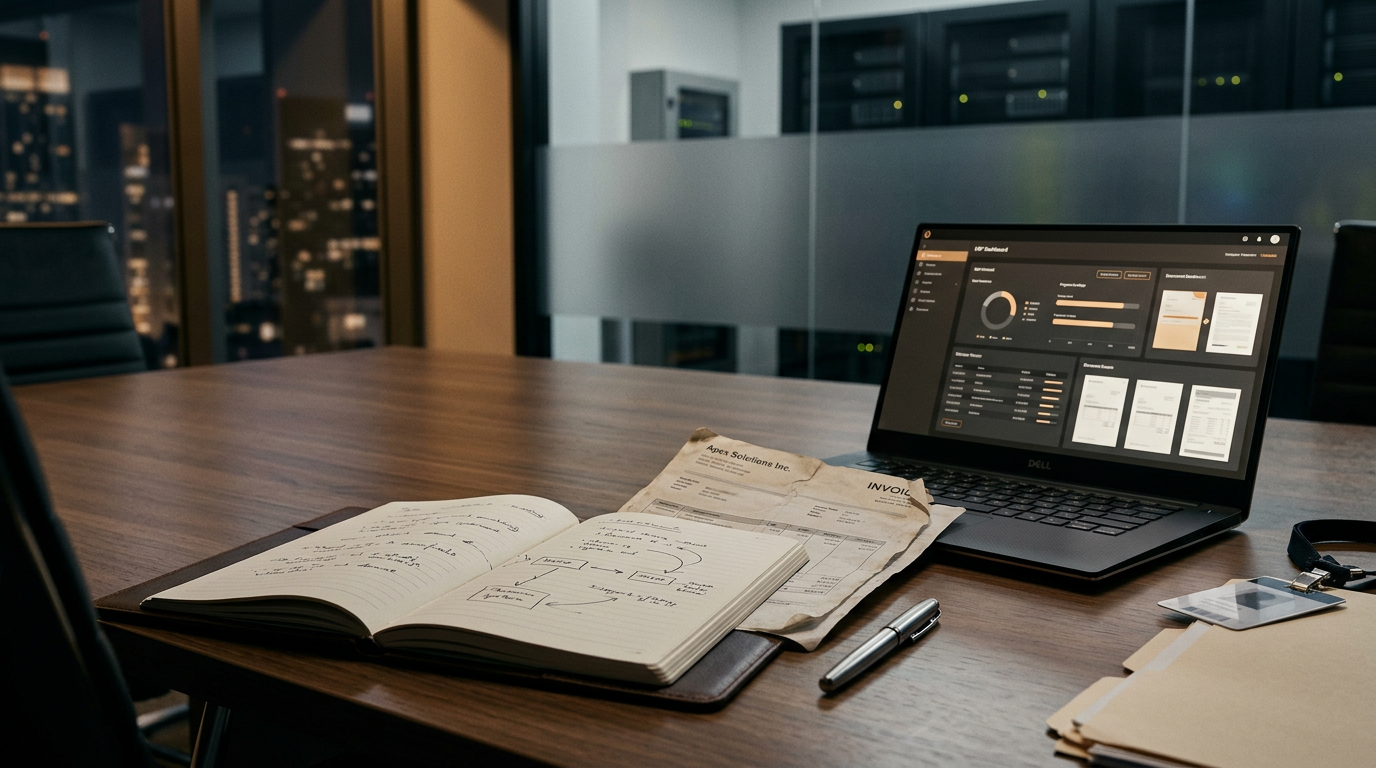
Legacy Optical Character Recognition (OCR) is a failing technology. For decades, Enterprise Resource Planning (ERP) systems have relied on rigid structural parsing—coordinate-based templates that break the moment a vendor moves a logo or adds a line item. The financial operations bottleneck isn't the data entry itself, but the "reconciliation friction" caused by documents that don't fit the mold: skewed PDFs, blurred mobile photos of bills of lading, and multi-page invoices with nested tables. Vision-Language Models (VLMs) represent a fundamental shift from geometry-based extraction to semantic visual reasoning. By treating a document as a unified visual and textual scene rather than a collection of strings at X-Y coordinates, VLMs eliminate the need for thousands of brittle templates and allow for automated, zero-shot reconciliation against ERP records.
The Failure of Coordinate-based Extraction
Traditional document ingestion pipelines are built on a house of cards. They typically follow a linear path: OCR (converting pixels to text), then Layout Analysis (deciding what text belongs in which column), then Named Entity Recognition (labeling "Total" or "Tax"). This pipeline is highly susceptible to "cascading error." If the OCR misreads a "9" as an "8," the downstream financial matching is doomed. If a table spans two pages, the layout analyzer often fails to stitch the context together.
VLMs like GPT-4o, Claude 3.5 Sonnet, or open-source alternatives like LLaVA and Qwen-VL operate differently. They do not separate the visual data from the linguistic data. Because these models are trained on both images and text simultaneously, they understand that a handwritten "Paid" stamp over an invoice total changes the status of that document, even if the underlying OCR still reads the numerical balance. This "visual context" is exactly what human accounts payable (AP) clerks provide, and it is exactly what legacy automation lacks.
Semantic Mapping to ERP Schemas
The primary challenge in ERP ingestion is not just reading the data, but mapping it to a specific internal schema. A vendor might call a field "Invoice Number," while another calls it "Reference" and a third uses "Inv #."
A VLM-driven ingestion engine uses a technique called Visual Zero-Shot Extraction. Instead of training a model on 5,000 examples of a specific invoice type, you provide the model with a prompt and the document image. The prompt acts as the schema.
Why VLMs Outperform Specialized Models
- Implicit Normalization: The model recognizes that "Net 30" in the footer is a payment term and can automatically convert it to an ISO-8601 date.
- Spatial Reasoning: It understands that a signature at the bottom of a page validates the document, regardless of where the signature field is located.
- Implicit Arithmetic: VLMs can perform on-the-fly verification by summing line items to ensure they match the stated total, flagging it for human review if the math fails—a feature OCR cannot provide.
Architectural Requirements for High-Volume Ingestion
Moving from a demo to a production-grade ERP bridge requires more than an API key. To handle thousands of documents daily, the architecture must balance the high latency of VLMs with the precision of deterministic checks.
The industry-standard framework for this is the Visual RAG (Retrieval-Augmented Generation) pattern. In this setup, the VLM is not just a reader; it is a reasoner.
- Preprocessing: Intelligent deskewing and denoising to reduce token consumption.
- Contextual Injection: Feeding the VLM not just the image, but relevant metadata from the ERP (e.g., a list of open Purchase Order numbers) to narrow the search space.
- Schema Enforcement: Using tools like Pydantic or JSON Mode to ensure the VLM output strictly follows the ERP’s input requirements.
- Validation Loop: A deterministic script checks the VLM's extracted total against the sum of extracted line items.
By providing the VLM with the list of open POs, you transform the task from a "blind search" to a "verification task." The model is asked: "Does this image match PO #8892?" rather than "What is the number on this page?" This significantly increases accuracy.
Handling the 'Messy' Edge Cases
The real ROI of VLMs is found in the 20% of documents that currently require 80% of the manual labor. These are the "messy" cases where traditional automation fails.
- Multi-Page Tables: When an invoice lists 400 items across six pages, legacy systems often lose the header-to-line-item relationship. VLMs maintain a larger visual context window, allowing them to track the table structure across breaks.
- Handwritten Annotations: AP clerks often write "Received 10/12" or "Credit Applied" directly on physical papers. VLMs can read these annotations and update the ERP record accordingly, preserving the audit trail.
- Ambiguous Labels: In logistics, a "Tote" might be a unit of measure or a physical location. A VLM uses the surrounding visual context (e.g., photos of the shipping label alongside the manifest) to disambiguate the term.
The tradeoff here is cost and speed. VLMs are significantly more expensive per document than Tesseract or AWS Textract. However, the cost of a VLM call (approximately $0.02 to $0.05) is negligible compared to the fully burdened cost of a human clerk spending three minutes verifying a failed OCR capture.
Implementation: The Hybrid Strategy
Organizations should not move to an all-VLM approach immediately. Instead, a tiered ingestion logic is the most fiscally responsible path.
- Tier 1 (High Confidence): Use standard OCR or EDI for high-volume, standardized vendors.
- Tier 2 (The VLM Layer): Route all documents that fail Tier 1 confidence scores to a VLM for reasoning and extraction.
- Tier 3 (Human-in-the-Loop): Use humans only for documents where the VLM flags a "Reasoning Discordance" (e.g., when it cannot reconcile the visual data with the ERP's expectations).
This hybrid approach reduces manual intervention by up to 90% while keeping compute costs optimized. It transforms the AP department from a data-entry shop into an exception-handling team.
What this means
The era of template-based document processing is over. Relying on coordinate-based OCR forces a business to remain static, penalized by every minor change a vendor makes to their billing format. By adopting Vision-Language Models, enterprises can finally treat financial documents as sources of truth rather than obstacles to be parsed. The shift to VLM-based ingestion is not just about automation; it is about building a resilient financial stack that possesses the visual intelligence to handle the inherent messiness of global commerce without human intervention.